A driveway that doesn't sink at the apron or crack at the garage
Most Grand Strand driveways fail in the same two places: where they meet the street and where they meet the garage. Ours are built on a compacted base, jointed where the slab wants to move, and permitted to whichever road owner the apron belongs to.
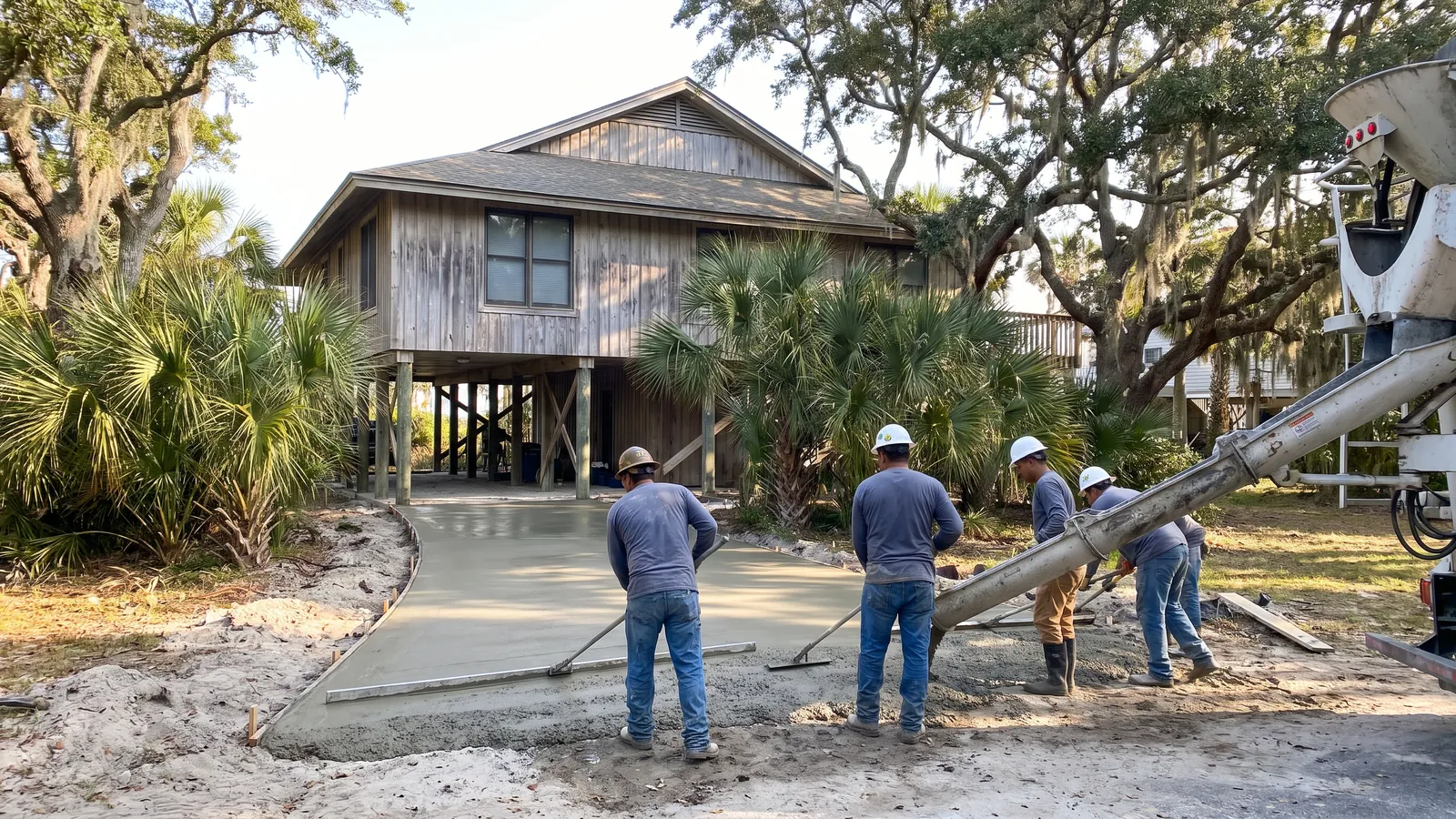
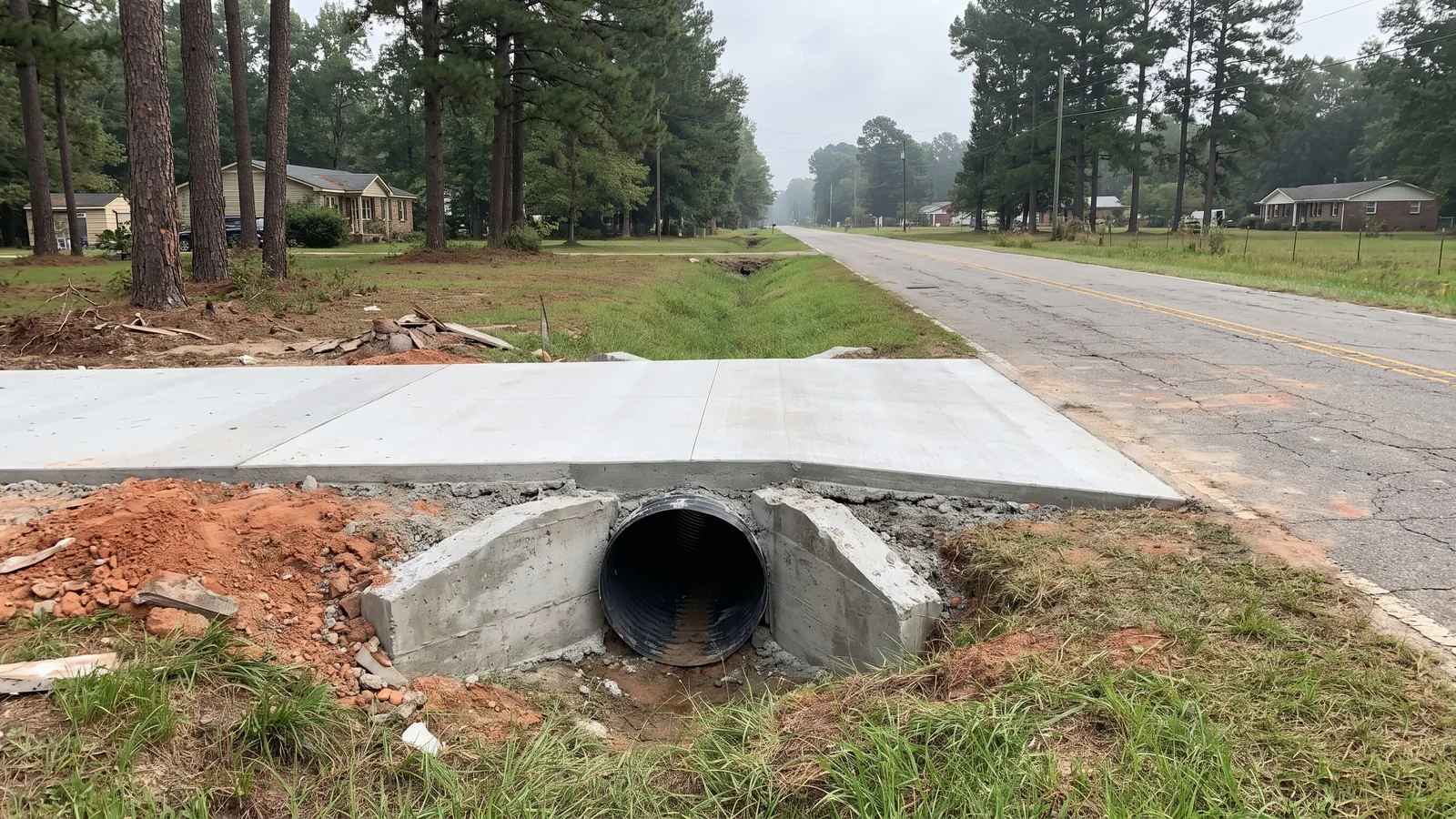
A driveway on the Grand Strand is two jobs. The part on your lot is yours: four inches of air-entrained concrete over four inches of compacted base, fiber mesh or epoxy-coated rebar on chairs (never bare wire mesh lying on the sand, which rusts in the salt air and spalls the slab), control joints every eight to ten feet so the cracks happen where we planned them, and an expansion joint against the garage so the house and the drive can move separately. The part in the right-of-way — the apron — belongs to whoever owns the road, and it has its own spec and its own permit. Inside the City of Myrtle Beach that means six inches thick, 3,000 psi, fiber mesh only, five-foot return radii, no more than twenty feet wide at the property line, nothing within five feet of a side property line or twenty feet of a corner, an expansion joint at the line, and a form inspection before we pour. In unincorporated Horry County the driveway itself needs no building permit, but the apron needs a free encroachment permit from County Engineering with 72 hours' notice, four inches minimum, and a pipe in the ditch where there is one. On a state road it's SCDOT's permit. We know which is which from the address.
Then the ground. East of the Waterway the subgrade is sand — well-drained on the dune ridges, poorly drained Leon sand with a hardpan and a high water table in the flats — and sand that isn't plate-compacted in lifts moves the first time water runs through it, which is why so many 1970s–90s driveways in the city have dropped at the apron over the utility trench. West of the Waterway toward Conway the soil turns to clay that heaves. We cut to grade, compact the subgrade, bring in crusher run or clean fill and compact that too, and we slope the whole thing a quarter-inch per foot away from the house without sending the water onto the neighbor, which the county's stormwater ordinance forbids. Pours start at first light, you can walk on it the next day and park on it in a week.
What's included
Right-of-way permit handled
City of Myrtle Beach apron permit, Horry County or SCDOT encroachment permit, North Myrtle Beach or Conway's version — pulled before the truck is ordered, inspections scheduled.
Base built for sand
Subgrade cut and plate-compacted, 4 in of compacted base, no slab on loose fill.
Reinforcement that doesn't rust
Fiber mesh in the apron per city spec; fiber or epoxy-coated rebar on chairs elsewhere. No bare mesh on the sand.
Joints where the cracks go
Control joints at 8–10 ft, expansion joints at the property line and the garage.
Drainage
Graded away from the house; ditch, swale and culvert flow preserved.
Removal and haul-off
Old concrete broken out and landfilled at the county's $15-a-ton rate, on the estimate as its own line.
Concrete driveways cost in Myrtle Beach, SC
| Job | Typical price | Notes |
|---|---|---|
| Single-car driveway, 10 × 40 ft (400 sq ft) | $2,800 – $4,500 | Broom finish, fiber reinforced |
| Two-car driveway, 20 × 30 ft (600 sq ft) | $4,000 – $6,500 | The most common Grand Strand size |
| Long drive to a raised beach house, 1,000 sq ft | $7,000 – $11,000 | Plus the apron and any culvert |
| City apron, 6 in / 3,000 psi / fiber | $1,200 – $2,800 | Permit and two inspections included |
| County apron with culvert pipe | $1,800 – $4,500 | Pipe, bedding, poured end sections, encroachment permit |
| Driveway widening or parking pad add-on | $1,200 – $3,500 | Tied to the existing slab with dowels |
| Tear-out of the old driveway | $1.10 – $1.80 / sq ft | Plus landfill tipping |
| Stamped or colored upgrade | + $5 – $10 / sq ft | See stamped concrete |
These are 2026 Grand Strand ranges so you can budget. Your written price is itemized — removal, base, thickness, reinforcement, finish, joints, the permit and its inspections — and good for 30 days.
Recent work
Questions we get about concrete driveways
How thick should a driveway be in Myrtle Beach?
Four inches on your lot for cars and light trucks, five or six where a boat trailer, an RV or a delivery truck will sit, and six inches at the apron inside the City of Myrtle Beach because the city's spec says so. Thickness matters less than the base under it: a four-inch slab on compacted base outlasts a six-inch slab on loose sand.
Do I need a permit for a new driveway?
For the apron in the right-of-way, yes, almost everywhere: the city's Construction Services permit inside Myrtle Beach, a free Horry County encroachment permit on county roads, an SCDOT permit on state routes, and North Myrtle Beach, Conway and Surfside have their own. The driveway on your own lot is exempt from a building permit in the county. HOAs usually want to approve the drawing. We handle all of it. See the permit guide.
Why did my old driveway sink at the street?
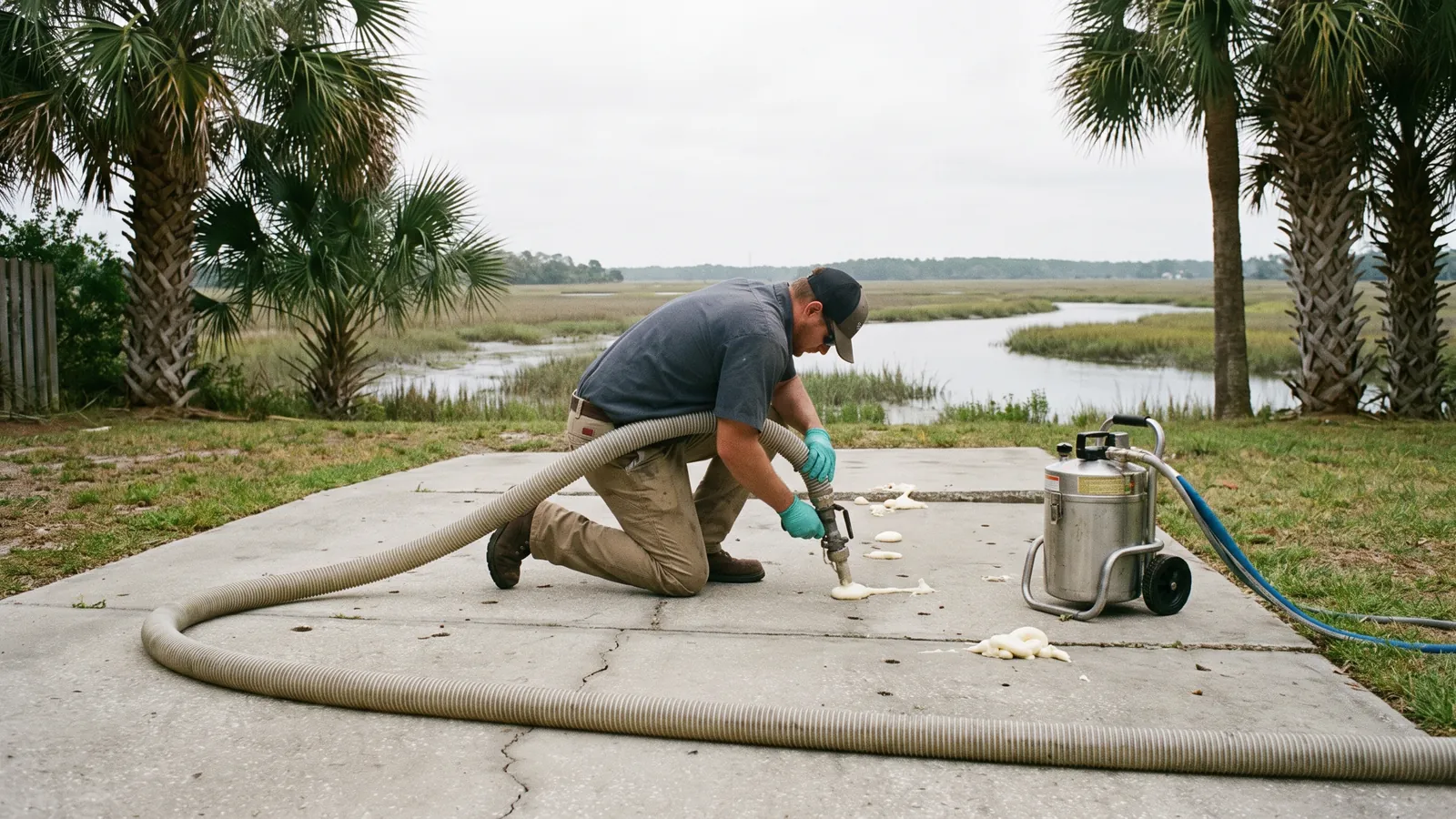
The original builder poured over the utility trench and the ditch backfill without compacting it, and thirty years of rain moved the sand out from under the slab. Depending on how far it's dropped it can be foam-lifted for a few hundred dollars or replaced to the current spec. We'll tell you which.
Can you widen my driveway for a second car or a golf cart?
Yes. The new slab is doweled into the old one so they move together, and matched for finish. Inside the city the total width at the property line can't exceed twenty feet, so wide drives flare after the sidewalk; HOAs in Carolina Forest and the golf communities usually want a plat with the application.
How long before I can park on it?
Walk on it the next day, park a car in seven days, park a heavy truck or trailer in 28. Summer pours cure faster but we keep them wet for the first days so they don't crack in the heat.