Why concrete sinks and cracks on the Grand Strand
It isn't bad luck. The sand ridge Myrtle Beach sits on, the hardpan under the flats, the clay toward Conway, four hundred Carolina bays and the salt in the air each break concrete in a specific, predictable way. Here's each one, and the fix.
The sand ridge
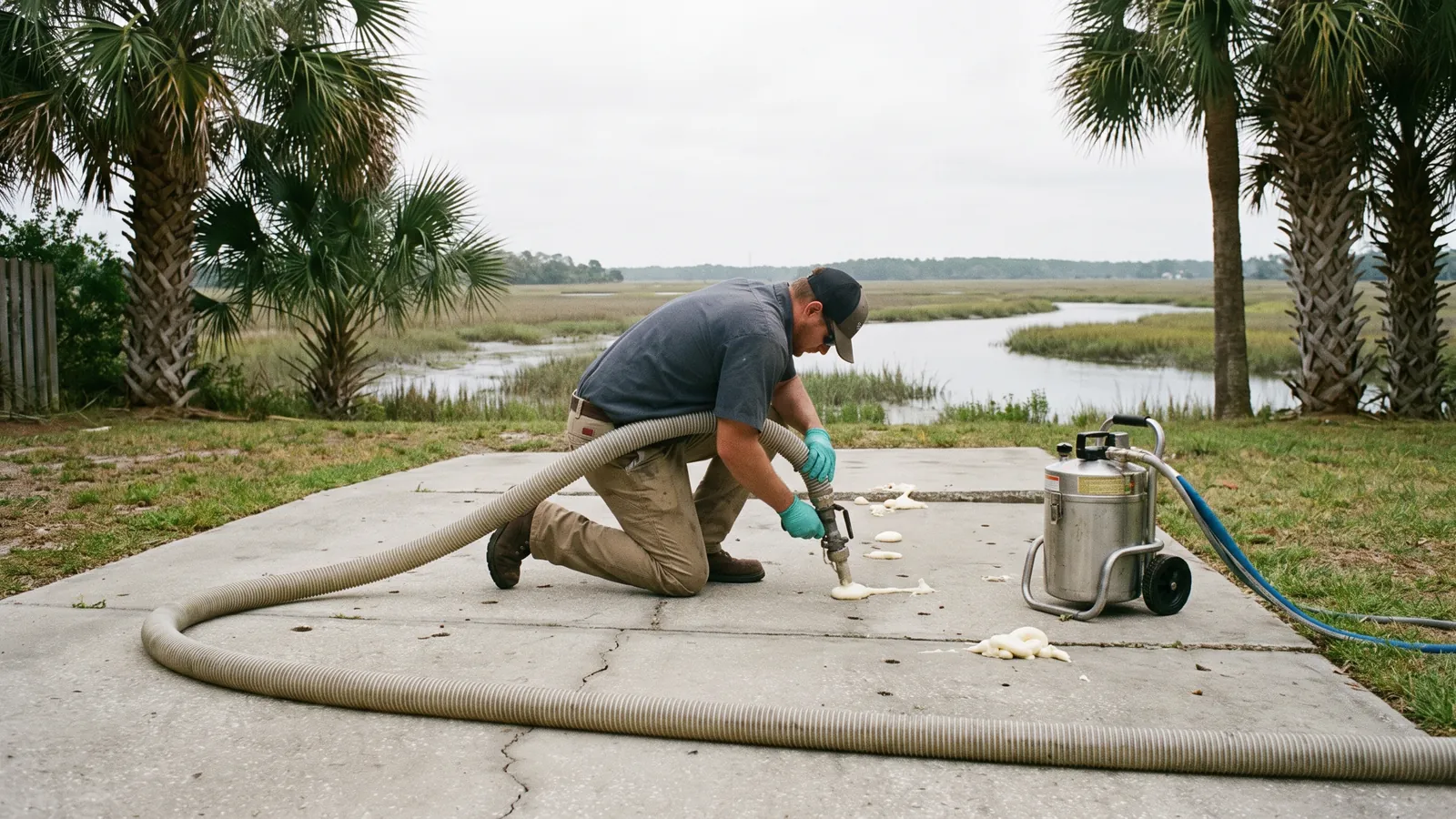
Myrtle Beach sits on a Pleistocene barrier complex — the sand ridges the Atlantic built and abandoned as sea level rose and fell, the same ridges that pushed the Pee Dee, Waccamaw and Black rivers south to Winyah Bay. The 1986 soil survey maps the oceanfront as the Lakeland-Leon-Newhan unit: excessively drained dune sands on the ridges and poorly drained sands in the low ground between. Clean, well-drained sand like Lakeland (water table deeper than 80 inches) is fine ground for a slab — if it's compacted. Loose sand isn't: water moving through it carries the fine particles away from under the slab, a void opens, and the slab drops into it. That's the mechanism behind nearly every sunken apron in the city: the utility trench and the ditch backfill were never compacted, and thirty years of rain moved the sand.
The hardpan and the water table
Behind the dune ridges the ground is Leon and Lynn Haven sand, and the survey is blunt about it: "wetness and ponding severely limit the soils for use as sites for dwellings and local roads." Leon sand has a spodic hardpan — a cemented layer of organic matter and iron — within about thirty inches of the surface, and the water table sits on top of it at half a foot to a foot and a half for months at a time. Socastee, Burgess, much of Forestbrook and the flats behind Surfside and Garden City are on it. A slab poured on saturated sand loses its support every wet season; a trench for a footing fills with water; and a driveway graded even slightly wrong holds a puddle that works on the base all winter. The fix is a compacted base above the wet zone, grading that moves water off and away, and foundations that the engineer sizes for the water, not the sand.
The Carolina bays
Horry County has 410 Carolina bays larger than two acres — more than any county in South Carolina — the elliptical, northwest-southeast-oriented depressions with peat and muck bottoms that the developers of Carolina Forest and the 544 corridor graded around and sometimes over. A slab on a filled bay edge sits on compressible organic material that keeps settling for decades. We probe the subgrade on any lot that might be one, compact and test the fill, and on a bad one we excavate and replace it before a slab goes down.
The clay
Cross the Waterway and the sands run out. The river terraces around Conway, Red Hill, Loris and Aynor are the clayey Yauhannah, Ogeechee, Bladen, Meggett and Wahee soils — poorly drained, slow to dry, and prone to swelling when wet and shrinking when dry. A slab on bare clay heaves in the winter and settles in the summer, and cracks across the middle when it does. The fix is a deeper cut, a compacted granular base between the clay and the concrete, joints that give the slab somewhere to move, and keeping water away from the slab edge so the clay under it doesn't cycle.
The salt
Within reach of ocean spray — which is most of the Strand east of 17 — chlorides find any steel near the surface of a slab. The welded wire mesh the builders laid directly on the sand in the 1970s and 80s ended up at the bottom of the slab or exposed at a crack, rusted, expanded, and spalled the surface off in sheets around the rust lines. The American Concrete Institute classes seawater spray as exposure class C2: a maximum water-cement ratio of 0.40 and at least 5,000 psi for the most exposed work. We use a dense air-entrained mix, fiber reinforcement or epoxy-coated rebar set on chairs in the middle of the slab, and a sealer on decorative work — and we never lay bare mesh on the sand.
The shrinkage nobody can stop
All concrete shrinks as it cures and all of it cracks somewhere. Control joints — cut or tooled to a quarter of the slab's depth every eight to ten feet on a driveway, four to five on a walk — tell it where. A slab without joints cracks across the middle; a slab with them cracks in the joints and nobody notices. Expansion joints at the house, the garage and the property line let the slab move independently of the things it touches.
What to do with the slab you have
A sound slab that's sunk can usually be foam-lifted back to grade. A slab that's cracked but level can be sealed. A slab that's spalling from rust, cracked into pieces or heaving on clay is a replacement, and the replacement is where the base, the reinforcement and the drainage get done right the first time. See repair and leveling.
Common questions
Can you tell what my ground is before you quote?
Yes — we probe the subgrade on the visit, and the soil survey tells us the unit. Sand, hardpan flats, bay edge or clay each get a different base, and the estimate says which.
Why did my neighbor's driveway last and mine didn't?
Usually the base and the reinforcement, not the concrete. Two drives on the same street poured the same year can have one on a compacted base with chaired steel and one on loose sand with mesh on the bottom, and they age completely differently.
Is there anything to be done about the water table?
You can't lower it, but you can build above it: a compacted base that drains, grading that moves water away, and foundations the engineer designs for saturated ground. Pumping a footing trench before a pour is routine on the flats.
Will fiber mesh really replace rebar?
For flatwork — driveways, patios, walks, cart pads — fiber controls shrinkage cracking and can't rust, which is why the City of Myrtle Beach requires it in aprons. Structural slabs, thick pads and foundations still get steel, epoxy-coated and set on chairs where the salt can reach it.
Related: Repair & leveling · Concrete driveways · Conway · Carolina Forest